
The fundamental architecture of a data centre
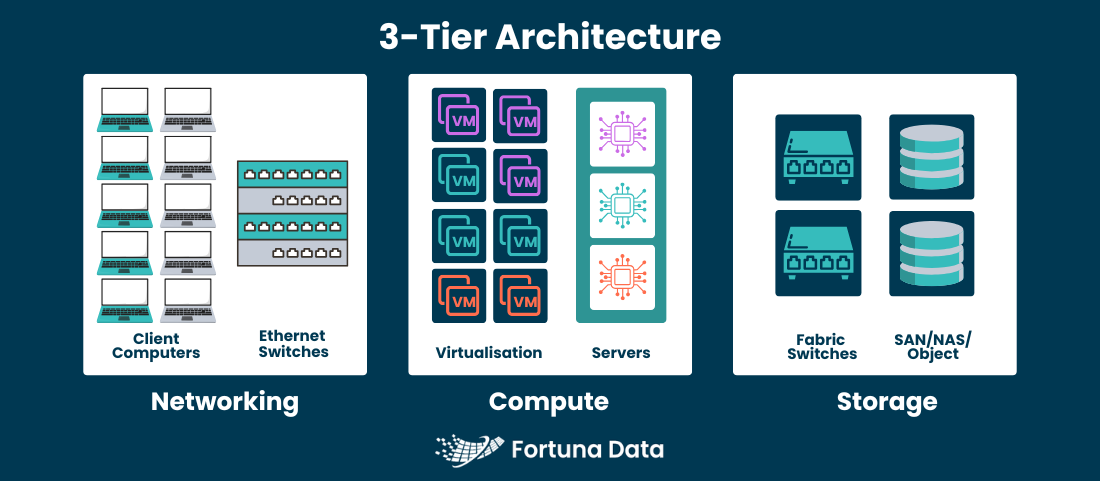
For the past 30+ years global organisations have been deploying a 3-tier architecture. It is easy to install, manage and expand, and comprises three primary components: servers, storage and a network fabric.
Servers
Run the operating systems and virtual machines (VMs) your applications depend on.
Network fabric
Connects the servers to the storage and to your wider network infrastructure.
Storage
Holds the data, whether local, on a NAS or on a SAN.
Two meanings. Software developers also use “3-tier” for an application split into presentation, logic and data layers. This page is mainly about the infrastructure meaning: servers, network and storage.
The idea behind a 3-tier architecture
In the beginning an organisation bought servers, loaded an operating system and connected storage, whether that was local, a NAS or a SAN. The server then connected to your network infrastructure.
Next came more powerful processors with multiple cores. This created the hypervisor and led to virtualisation appearing. Operating systems could now be segregated and the available server resources shared by creating VMs (virtual machines) on a single server.
The 3-tier architecture allows for the easy expansion of additional servers, storage or networking with little or no disruption to infrastructure. That is why it has lasted: it is straightforward and simple.
Introduction to the concept of 3 tier architecture
Understanding 3 tier architecture is essential for developers, project managers and IT professionals alike. By breaking down a structure into manageable parts, teams can enhance scalability, maintainability and performance. Whether you are building web apps or enterprise systems, grasping this concept will help streamline your processes.
Advantages and disadvantages of using a 3-tier architecture
Using a 3-tier architecture offers several advantages that can enhance an organisation's IT framework, but there are drawbacks to weigh up too.
Advantages
- Scalability. As businesses grow, you can add resources without disrupting existing systems.
- Maintainability. Each layer operates independently, so one part can be updated or modified without affecting the others. The separation also brings better organisation and clarity.
Disadvantages
- Complexity. Managing three distinct layers requires careful planning and skilled personnel.
- Cost. You may need more infrastructure and support staff.
- Performance. Latency problems can arise if communication between tiers is not optimised effectively.
Balancing these pros and cons is essential when deciding whether to adopt a 3-tier architecture in your projects or initiatives.
Weighing up 3-tier against hyper-converged?
Read our 3-tier architecture vs hyper-converged infrastructure comparison, or talk it through with a specialist.
How to implement a 3-tier architecture in your organisation
Implementing a 3-tier architecture in your organisation begins with assessing your current system. Identify the existing components that need separation into three distinct layers:
Servers
Make sure they are more than capable of handling the multiple VMs you will be running.
Data storage
It needs to handle multiple IOPS so users and data are not affected by performance bottlenecks.
Network
This is purely down to preference and could be iSCSI, Fibre Channel, Ethernet or FCoE.
Training staff is crucial for success. Educate them about their roles within this architecture to enhance productivity, and send them on training courses so they fully understand those roles.
Conduct thorough testing at every stage to identify any weaknesses or bottlenecks before going live. Regular updates will also keep your system performing optimally over time.
Challenges and potential solutions when working with a 3-tier architecture
Implementing a 3-tier architecture comes with its share of challenges.
Communication between tiers
Managing it is complex, and as your application grows, ensuring seamless interaction can become tricky.
Scalability
With increasing user loads you may hit performance bottlenecks that hinder responsiveness. Left unaddressed, this can lead to a poor user experience.
Security
Each layer requires distinct security measures to protect sensitive data from breaches or unauthorised access.
Patches and updates
An incorrectly administered patch or update can fail and lead to system downtime.
Potential solutions
- Microservices can enhance modularity and streamline interactions between components.
- Load balancers distribute traffic effectively across servers, improving scalability.
- Regular security audits identify vulnerabilities early on.
- Strong authentication and encryption throughout all layers improve overall system integrity and reduce risk significantly.
Summary
Understanding and using 3-tier architecture is essential for modern organisations. This approach offers a clear separation of concerns, making it easier to manage complex systems.
Embracing it equips organisations with the tools to provide access to applications and server resources. As technology rapidly evolves, understanding this framework becomes increasingly vital in ensuring a robust infrastructure capable of supporting future growth.
Is your 3-tier estate holding you back?
It is worth a conversation if any of these sound familiar:
- Performance bottlenecks between servers, network and storage.
- Patches and updates that risk downtime.
- Rising infrastructure and support costs.
- Skills stretched across three separate layers.
Tell us what you run today and we will talk you through your options, including whether hyper-converged would suit you better.
Prefer email? Write to solutions@data-storage.uk.
