
Menu
Connecting the world
Storage Networking comes in all types, configurations and complexities. At Fortuna Data we focus on providing storage networking for connecting IT infrastructure — whether that's connecting storage, servers or workstations together, using networking technologies for iSCSI and Fibre Channel.
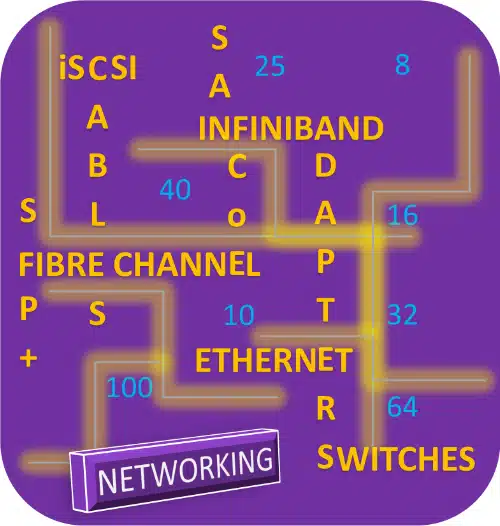
Today fibre channel speeds are 64Gbps, allowing the ability to connect 8/16/32Gbps networks and storage together.
Fibre Channel was developed to overcome the failings of using SCSI Ultra 160/320, such as:
Fibre Channel first appeared in 1994 and is the preferred method of connecting storage and servers together in a data centre.
Fibre channel uses optical cables running at 16–64Gbps, connected to fibre channel switches to provide block data from the storage to client/server machines. These networks provide high levels of security and performance, and typically run as a dedicated SAN (storage area network) purely designed for storage.
Both iSCSI and Fibre Channel use the SCSI (small computer systems interface) protocol to send commands to read, write, erase, and rewind storage devices.
The main difference between iSCSI and Fibre Channel is that Fibre Channel requires a dedicated adapter card, whereas iSCSI can run and utilise existing Ethernet network ports in a server or workstation.
iSCSI is used to connect storage and computers together. It's a transport layer protocol that operates in conjunction with the Ethernet TCP (transport control protocol) to deliver block-level SCSI data transport between the iSCSI initiator and the storage target over TCP/IP networks, making it a key component of storage networking.
We provide all types of iSCSI storage to deliver data blocks to operating systems and applications. Initially, iSCSI used 1GbE and then 10GbE; now it works over 25GbE, 40GbE, and 100GbE Ethernet networks, providing seamless disk space for virtualisation, operating systems, and many other applications that require additional disk space. This adaptability has strengthened its position in modern storage networking solutions.
An example of how iSCSI works: you could have 100 diskless workstations all connecting to an iSCSI SAN. These are then connected to iSCSI storage arrays and boot from this data source. This capability is widely employed in storage networking environments to streamline access to shared resources.
We provide a range of Ethernet switches that support Jumbo frames to deliver iSCSI data to clients or servers. Initially, iSCSI was based on 1GbE Ethernet; today, this support extends to 10/25/40/100GbE networks.
The most common type of iSCSI SAN in use today uses 10GbE, and these can use RJ-45 copper or SFP+ optical cables. The primary difference between an iSCSI and Fibre Channel network is that an iSCSI SAN can run over a normal gigabit network, further broadening the appeal of iSCSI within storage networking setups.
iSCSI is a storage networking protocol that encompasses block-level SCSI data in a TCP/IP frame, allowing servers to access iSCSI storage resources over an existing IP infrastructure. It's a cost-effective way to build SANs at a much lower cost point, giving users greater consolidation in their environment.
If you need some guidance in choosing either a Fibre Channel or iSCSI SAN, we're here to help.
Weighing up Fibre Channel or iSCSI for your storage network? Talk to us for free, no-obligation advice.
Talk to a Specialist