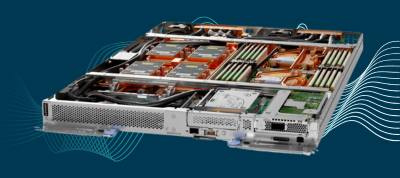
Optimised for scalability, space and energy efficiency
What Is a Blade Server?
A blade server is a stripped-down computer that houses the CPU, memory, network connectivity, hard drives/SSD/NVMe, graphics, storage I/O and management.
It is designed to be energy and space efficient, allowing a business to scale its compute requirements as it grows, simply by adding another server blade into the blade chassis.
A blade server is essentially a modular sliver of server that can be populated with the necessary compute and added to the chassis to scale as and when required.
Due to the compartmented nature of a blade chassis, they tend to have a far higher supported lifespan than traditional rackmount servers.
The Lenovo ThinkSystem SD650-N V2 Nodes is a dual-socket 6U rackmount server enclosure that supports the 3rd Gen Intel® Xeon® Scalable processors with NVIDIA HGX™ A100 4-GPU acceleration and NVIDIA HDR InfiniBand networking.
A blade simply inserts into the blade chassis. The chassis interconnects with all the servers and houses the cooling, power, networking, storage I/O and management via a backplane. In simple terms, it is an empty shell to which you insert servers.
Advantages of a Blade Server
Below are some of the advantages of using a blade chassis over individual rackmount servers:
Reduced network complexity — Typically, 10 rackmount servers means 10 management connections. A blade server can house 10 servers and have a single management port for them all.
Reduced power consumption — Each rackmount server would normally have 2 PSUs, so 10 servers means 20 power leads. A blade chassis houses all the power it requires with just 4 power leads to run the whole chassis. There are also energy savings, since the power supplies are optimised to run more efficiently.
Reduced network traffic — Having multiple servers housed in a blade chassis means communication between the blade servers is contained within the chassis rather than broadcasting across the whole network.
Enhanced security — The blade chassis is a completely self-contained data centre, with all components housed in a modular chassis that can be rack mounted or floor standing. Due to the design it is very easy to secure a server from outside attacks, as much of the compute and processing is done within the chassis.
Reduced cooling — A blade chassis is optimised and designed to cool multiple blade servers. This greatly reduces the number of fans required, as many components on a blade server are airflow optimised — for example, processors are mounted at the back of the server nearer to the fans.
Reduced expenditure — If a business is growing rapidly and the compute requirement over a 2–3 year period can be measured, then a blade server makes perfect financial sense. The biggest expenditure is the blade chassis to house the servers, so the upfront cost will be more than purchasing individual rackmount servers — however, once you start to scale beyond four or six servers, that upfront cost is recouped, along with all the savings mentioned above.
Physical space savings — A blade chassis is highly dense and compact: a 10U blade chassis can house up to 14 blades. 14 rack mount servers could easily take up 14U or 28U, depending on server size.
Fault tolerant — A blade chassis is designed to be fault tolerant, supporting failures of key components such as blade servers, switches, backplanes, power supplies, fans, data storage and I/O. If a blade fails, simply slide it out and replace it.
Greater support life — A blade chassis can be supported by the manufacturer for 10+ years, whereas a normal server is typically supported for 5 years.
Application Use Cases
As a chassis houses multiple blades, it is ideal for all the following applications:
Virtualisation — powerful enough to run a virtual infrastructure to provide VMs for applications, or be used for VDI to deliver a virtual desktop environment
A blade can run the same applications as a normal server
Limitations of Using a Blade Chassis
A chassis has many benefits over rackmount servers, but there are some limitations, as shown below:
Pricing — the business needs to ensure the blade chassis will fill most of the empty blade slots and that the application(s) can take advantage of this type of configuration, for a decent ROI
A blade server cannot be upgraded to support faster network speeds unless the backplane can handle it
They suffer with limited data storage space, as most only support 1 or 2 drives
If a software application requires a very high network or storage requirement, a rackmount server would be a better choice
The network switch port density is less than a data centre switch
If you need some guidance in choosing a suitable blade server chassis for your requirement or application, we're here to help.
Weighing up blade servers vs rackmount for your environment? Talk to us for free, no-obligation advice.