
Menu
Explore the pros and cons of 3-tier architecture and hyper converged infrastructure with Fortuna Data. Find the perfect data storage solution for your business needs.
Many organisations have pools of storage on premise and in the cloud and this takes many forms File, Block, Object, DAS, SAN, NAS, Buckets. Whilst many organisations are preferring to use the cloud for their off-premise storage there are many organisations now looking at being “Cloud Smart”. They have realised that there are many use cases where the cloud is no longer suitable or too costly to store data for long periods of time.
In this article we look at two competing types of storage technologies that are completely different in how they are architected and more importantly how they function and operate.
Learn how enterprises address data trust, fragmentation, and scale.
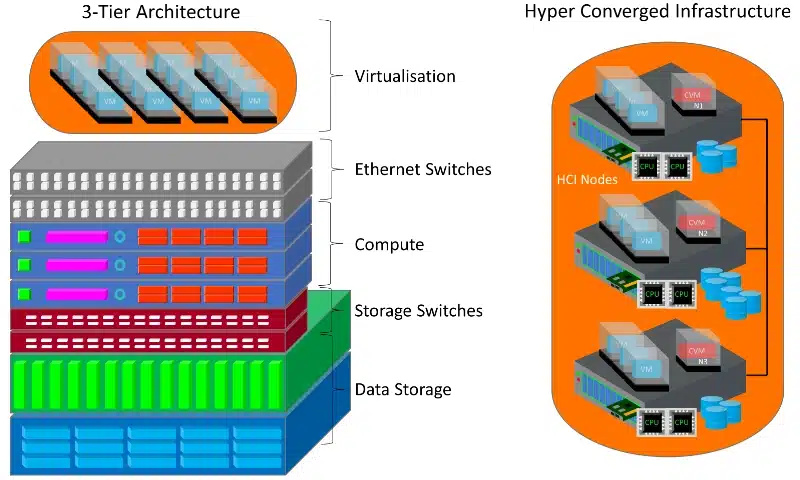
The first is a traditional 3-tier architecture comprising of servers, storage, networking, and a software hypervisor.
Advantages of a 3-Tier Architecture:
While the 3-tier architecture offers numerous advantages, it is not without its downsides. One of the main disadvantages is increased complexity. With three layers - presentation, application, and data storage - there are more components to manage and maintain.
A three-tier architecture offers many benefits in terms of modularity, scalability, and maintainability. However, it also comes with added complexity, potential performance overhead, and increased infrastructure costs. The choice of whether to use a three-tier architecture should be based on the specific requirements and goals of the organisation.
The second is a hyper converged infrastructure (HCI) running a software layer on top of servers to provide file, block, object storage and/or a hypervisor and managed as a cluster.
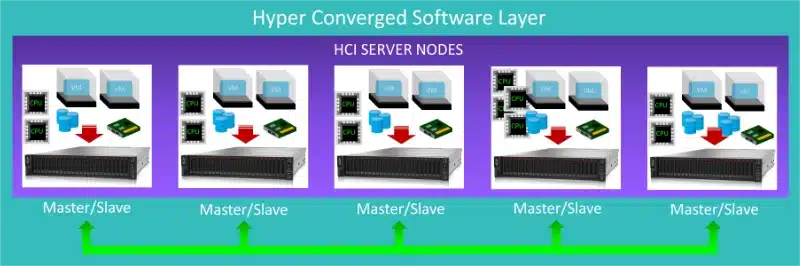
In summary, Hyper converged infrastructure offers advantages such as simplified management, scalability, cost efficiency, and performance improvements. However, organisations should carefully consider the initial costs, potential vendor lock-in, and the suitability of HCI for their specific workloads and requirements before adopting this infrastructure approach.
I have been working with a billion-pound turnover organisation who have traditionally purchased a 3-tier solution and whilst this has served them, they want the flexibility to include other areas of the business where a 3-tier architecture wouldn’t work for example, ROBO (remote office branch office), Edge, DR, VDI). With less money being invested in IT and a reduced IT headcount Hyper converged infrastructure offers many advantages for example all systems can be managed centrally.
If you would like to know more about the 3-tier or HCI solutions we provide please contact us using the details below.
