
Menu
Fibre Channel is a dedicated, high-speed network built for one job: moving block storage between servers and storage arrays with low, predictable latency. It remains the backbone of storage area networks (SANs) in banks, hospitals, manufacturers and any organisation running mission-critical databases and virtualisation. Fortuna Data helps UK organisations choose, supply and support the right Fibre Channel SAN for their workloads.
Fibre Channel (FC) is a storage networking protocol that connects servers to shared block storage over its own dedicated network, separate from your everyday Ethernet LAN. Servers see the storage as if it were a local disk, which makes FC well suited to databases, virtual machine datastores and other latency-sensitive applications.
Fibre Channel carries SCSI commands (and, on modern hardware, NVMe commands) across a lossless network, so data arrives in order without the retransmissions that can occur on busy Ethernet networks.

A Fibre Channel SAN has four main building blocks:
Every port has a unique World Wide Name (WWN). Zoning on the switches controls which servers can see which storage, and LUN masking on the array controls which volumes each server can access. Together they keep the SAN secure and organised.
Many servers can connect to the same storage array. When several servers need to share the same volume — for example a VMware cluster — a cluster-aware file system such as VMware VMFS or Windows Cluster Shared Volumes manages access so data stays consistent.
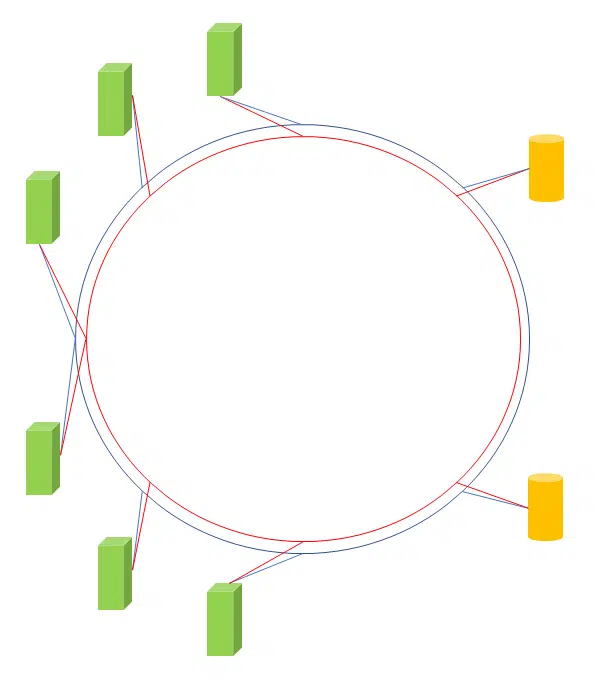
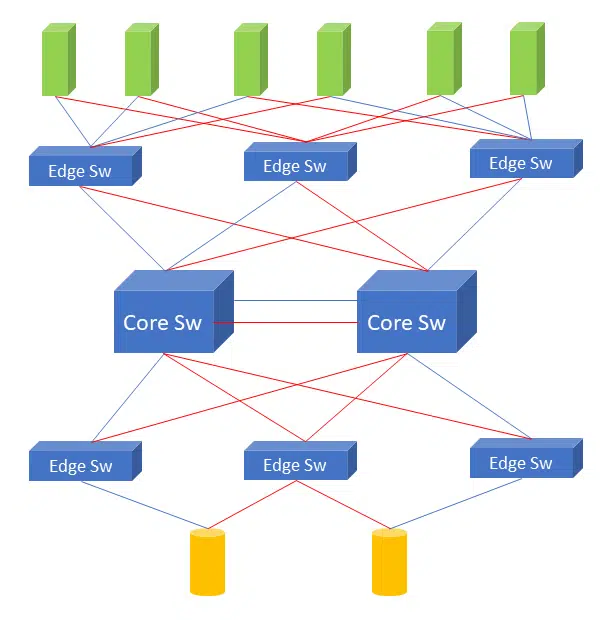
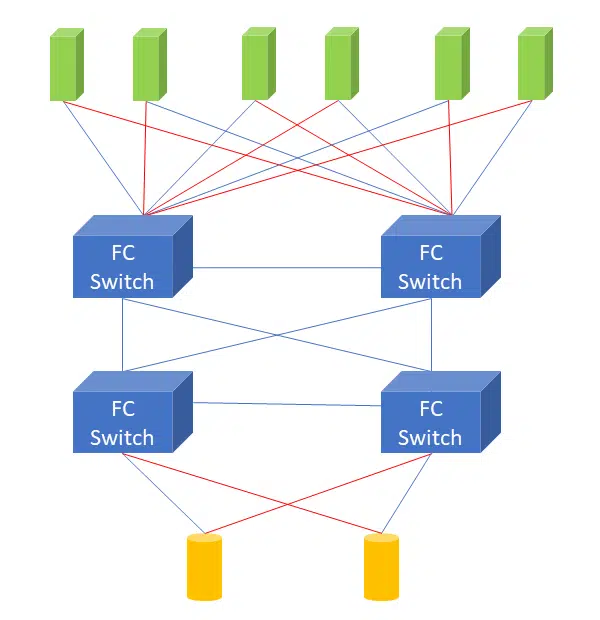
Fibre Channel generations:
Fibre Channel hardware is typically backward compatible with earlier generations, so new switches and HBAs can usually be introduced alongside existing equipment. We'll check compatibility across your estate before you buy.
Fibre Channel – a dedicated, lossless storage network. Predictable low latency, isolated from LAN traffic, and mature management tools. Needs its own switches, HBAs and cabling.
iSCSI – runs block storage over standard Ethernet and TCP/IP. Lower cost and uses familiar networking skills, but shares infrastructure and needs careful design to deliver consistent performance. Learn more about iSCSI storage
NVMe over Fabrics – carries the fast NVMe protocol across a network. It can run over Fibre Channel (FC-NVMe), letting you use an existing FC SAN, or over Ethernet (NVMe/TCP or RoCE). Most modern Fibre Channel hardware supports FC-NVMe — we'll confirm this for your HBAs, switches and array. Learn more about NVMe over Fabrics
Short version: if you run mission-critical workloads and already have Fibre Channel, it remains a strong choice. If you're starting fresh on a tighter budget, iSCSI or NVMe/TCP may be a better fit. We'll recommend what suits your workloads, not what suits us.
Connecting servers to shared block storage where performance and reliability matter most — databases, virtualisation, ERP and other mission-critical applications.
Fibre Channel usually delivers lower and more predictable latency because it runs on a dedicated, lossless network. A well-designed iSCSI network can perform well too, but it shares Ethernet infrastructure and needs more careful tuning.
Common speeds today are 32G (Gen 6) and 64G (Gen 7). Gen 8 128G switches were launched in November 2025.
Usually, yes. Fibre Channel hardware is typically backward compatible with earlier generations, but always check compatibility across your switches, HBAs and storage before upgrading.
Yes. Many servers can connect to one array. To share the same volume safely, use a cluster-aware file system such as VMware VMFS or Windows Cluster Shared Volumes.
Zoning is configured on the Fibre Channel switches and controls which servers can communicate with which storage ports. It keeps the SAN secure and prevents servers seeing storage they shouldn't.
Talk to Fortuna Data about the right Fibre Channel setup for your workloads and budget.
Request a Quote