
Menu
What is computing on the edge?
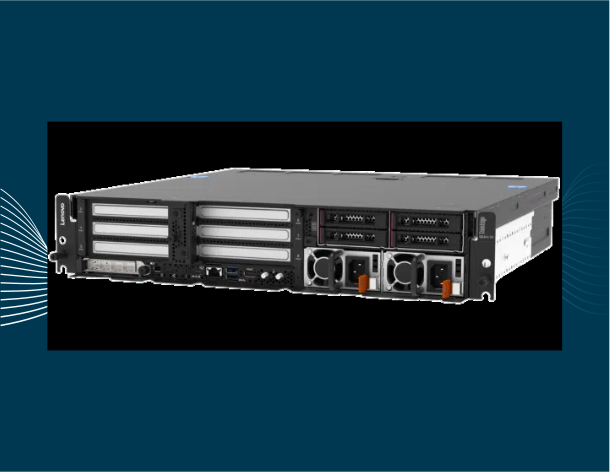
It's the centre of action. And Lenovo's ThinkEdge SE455 V3 is the rugged, short-depth, single-socket server purpose-built to thrive in that environment.
Get to Know Lenovo ThinkEdge SE455 V3 Server →In the fast-changing world we live in today, businesses are reducing their data centre footprints and adopting a cloud model, where information is collected, stored and processed. It isn't quite that simple, however, as the data generated requires far bigger transmission pipes than are currently available or that companies can afford.
Although data centres are shrinking due to advances in technology, applications and computing are now being taken out of the data centre and deployed in the field as edge computing devices. Many of these applications — IoT, mobile devices, smart devices, AI, gaming, machine learning, content caching and more — all require the information to reside locally where demand is localised. This requirement has led to edge computing servers that provide compute, storage and network connectivity on the edge.
Deploying edge computing servers remotely across the globe opens up many new applications and markets for businesses globally. Below are some edge computing server ideas and use cases:
Edge computing servers remove the requirement to process information in a data centre, as this isn't a realistic option given network bandwidth, latency limitations and security concerns that limit how much data a business can process at any one time at its headquarters. Most of the time this data needs to be processed in real time — but due to latency, it could take many minutes to process the information centrally, by which time the event has passed.
With newer applications being pushed out of the data centre and residing locally, there is an increasing requirement to move to edge servers that can take advantage of the business network or use the internet to process information locally, then upload the results when time permits, bandwidth is available, or when the results are needed. This is where the idea of edge servers was born.
Edge computing servers require a secure, rugged, small, powerful, low-powered server that can handle an environment where air conditioning doesn't exist. Lenovo has created a new market for servers residing outside of the data centre, and the Lenovo SE350 edge computing server is designed to work in this environment. It can process information locally, avoiding costly transmission times, to provide real-time data analytics — for example on traffic flow, document checking at passport control, number plate recognition, or many other new and emerging areas where information processing must happen instantly.
Not sure which edge computing server fits your deployment? Talk to us about the right configuration for your environment.
Talk to a Specialist →Security using edge servers is a big issue for any business. In a data centre, servers are protected and monitored around the clock; in the field, they are not. One of the first things Lenovo thought about was data security and protection — an edge computing server small enough to fit under your arm is also easy to steal if it resides in a portable cabin. The Lenovo SE350 has been designed with both physical and electronic protection from the outset. Physical protection is handled using a variety of mounting options — floor, ceiling, vertical, horizontal or rackmount — plus a Kensington lock; while this won't stop the most determined thieves, it helps. Electronic protection features include shock, vibration and movement detection via a shock sensor and built-in gyroscope. If any of these features are triggered, the edge server automatically deletes the encryption keys used to access the data stored on its M.2 drives, rendering the information useless.
Edge computing servers sit on the periphery of networks, processing information close to where it's generated. An edge computing server might need to connect via Wi-Fi, Internet or LAN — and Lenovo has thought of this, with connectivity options of 10/100Mb/s, 1Gb/s or 10Gb/s, including Wi-Fi and internet options.
Edge computing servers in the field may require an IT engineer's attention, but that engineer could be miles away. Remote management and reporting are therefore a key requirement for deploying edge computing devices in the field. The Lenovo SE350 integrates with Lenovo XClarity, allowing you to deploy and manage your entire edge computing environment through a simple and intuitive GUI.
An edge computing server won't have the fastest processors found in a 2U rackmount server residing at the data centre — but it needs to be powerful enough to run a variety of operating systems and applications, support a GPU for image recognition, or run a hypervisor to support remote desktops. The Lenovo SE350 supports a single Intel Xeon D processor, with up to 16 cores, core speeds of up to 2.2 GHz, and TDP ratings of up to 100W. A high-powered processor also needs a large amount of memory to support those cores and applications — the SE350 supports up to 4 TruDDR4 memory DIMMs and up to 256GB of memory using 64GB DIMMs.
In an edge computing environment, data is constantly being generated and processed. The raw data could be uploaded to the cloud or sent back to the data centre, but the problem with this approach is available network bandwidth and time. It's far better to process the information locally, upload the results, and discard the rest — in time to start again. The Lenovo SE350 supports up to eight M.2 NVMe drives of up to 2TB each, with or without RAID, plus support for an additional two M.2 drives for the operating system.
Edge computing devices are not going to sit in a nicely cooled data centre — they're more likely to be found in a telecoms rack, portable cabin or roadside cabinet where air conditioning doesn't exist, but fresh air does. A 2U rackmount server operating in these environments is unlikely to last more than three months, unless it's designed to cope. The Lenovo SE350 complies with ASHRAE A4 specifications: 5°C to 45°C (41°F to 113°F) operating, and rated for shipping to harsh remote environments at -40°C to 60°C (-40°F to 140°F).
Energy efficiency is a key requirement for deploying an edge computing device, since you're unlikely to have three-phase power in a field. The Lenovo SE350 supports 12V PDM or -48VDC PDM (-40VDC to -72VDC) using a single PSU, or a single or dual 100-240V, 20A 240W AC adapter.
Deploying an edge computing device greatly reduces internet bandwidth requirements, allows data to be processed locally in real time, greatly reduces the latency between the edge sensor or application and the result, and allows a business to create more powerful applications that operate remotely to provide greater insights.
In the data-driven world we now live in, new applications are pushing information towards the edge — literally. How this information is processed and handled requires agile IT departments to deliver these applications and process the information for the business to analyse. Lenovo clearly saw a market for this by launching the SE350, being among the first in a new market with huge growth potential.
Deploying compute at remote or unmanned sites? Talk to us for free, no-obligation advice on the right edge server.
Talk to a Specialist